
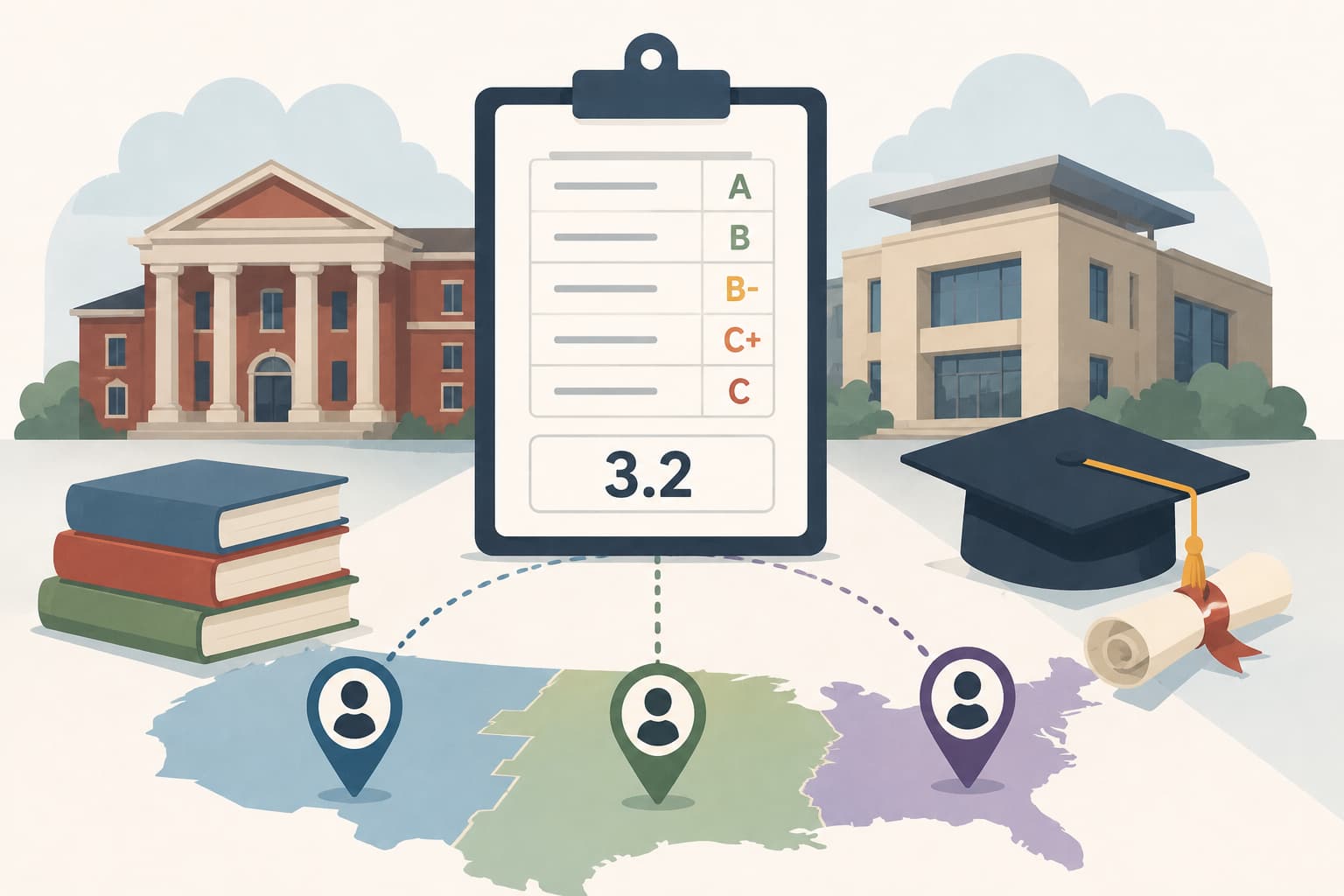
Understanding how the GPA system works in American universities is one of the first hurdles for any student, parent, or international applicant trying to make sense of higher education in the United States. At its core, the Grade Point Average is a single number that summarizes a student’s academic performance across all of their courses. It usually sits on a scale from 0.0 to 4.0, where an A is worth 4.0 grade points, a B is worth 3.0, a C is worth 2.0, a D is worth 1.0, and an F counts as 0.0. To arrive at the final figure, each course grade is multiplied by the number of credit hours that course carries, the results are added together, and the total is divided by the total number of credit hours attempted. This weighting by credit hours is the part many newcomers overlook. A top grade in a four-credit course pulls the average up far more than the same grade in a one-credit elective, which means that not all classes influence a transcript equally. Two students can finish a semester with the same letter grades on paper and still end up with different averages simply because of how those grades are distributed across heavier and lighter courses.
The picture becomes more complicated once you realize that the basic four-point scale is only the starting point. Many universities use pluses and minuses, so an A-minus might be recorded as 3.7 and a B-plus as 3.3 rather than rounding everything to whole numbers. Others do not use this refinement at all and treat every A the same regardless of whether it was earned at the top or the bottom of the grade band. Because of this, an identical performance can translate into a noticeably different GPA depending on the institution’s grading policy. There is also the distinction between a weighted and an unweighted average. An unweighted GPA treats every course the same, while a weighted GPA assigns extra points to more demanding classes such as honors courses or, at the high school level, Advanced Placement subjects. Under a weighted system, a student can sometimes exceed the traditional ceiling of 4.0 and land at a 4.3 or higher. This is precisely why a number on its own rarely tells the full story, and why admissions officers and employers look closely at the context behind it.
The way grades are awarded adds yet another layer of variation. Professors at American universities enjoy a great deal of independence in how they design and assess their courses, and there is no single national standard dictating what separates an A from a B. One instructor might reserve top marks for genuinely exceptional work, while another grades more generously, with the majority of the class earning high results. Some departments apply a curve that distributes grades across a fixed range regardless of raw scores, while others mark strictly against fixed criteria. The consequence is that the same effort and the same level of understanding can produce different grades in different classrooms, and those differences flow directly into the GPA. This is part of a broader phenomenon often discussed in American education, where average grades have crept steadily upward over the years. As high marks become more common, the gap between a strong student and an average one narrows on paper, and a given GPA carries a little less distinguishing power than it once did. A 3.8 from a department known for tough grading is not equivalent to a 3.8 from one where high grades are routine, even though the figure looks identical.
Context outside the individual classroom matters just as much. The reputation and rigor of the institution itself colors how a GPA is read. A respectable average from a famously demanding program may be viewed more favorably than a slightly higher one from a school with an easier reputation. International comparisons make this even clearer. Students arriving from other countries frequently discover that their home grading systems do not map neatly onto the American four-point scale. A grade considered excellent in one national system might convert into something more modest once translated, and the methods used for that conversion vary from one university to another. This means a transcript can be interpreted differently depending on who is reading it and what conversion table they rely on, which is a common source of confusion and occasional frustration for applicants.
It also helps to distinguish between the different averages a student accumulates over time. There is the cumulative GPA, which reflects an entire academic career, and the semester or term GPA, which captures performance during a single period. A weak start can drag down a cumulative figure for years, even after a student improves dramatically, while a single strong semester might not be enough to lift it quickly. Some programs and scholarships pay attention to one measure rather than the other, so the same student can appear to be performing well or poorly depending on which number is examined. Major-specific or departmental averages, which consider only the courses within a field of study, add still another way of slicing the same record.
For all these reasons, the GPA is best understood not as an absolute verdict but as a relative signal that requires interpretation. The same number can reflect very different realities depending on the grading scale, whether it is weighted, how strictly a professor marks, the rigor of the institution, and how an international record was converted. Students who grasp these mechanics are far better equipped to set realistic goals, choose their courses strategically, and explain their own transcripts with confidence when the time comes to apply for further study or work.